
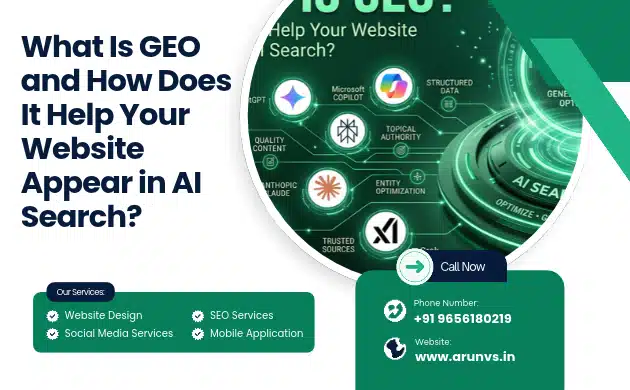
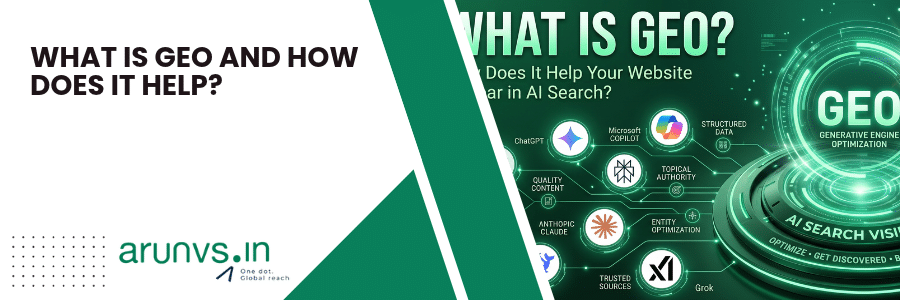
What Is GEO and How Does It Help
Getting traffic from Google is no longer enough for business success. Nowadays, more people ask ChatGPT, Google AI Overviews, Gemini and other artificial intelligence for recommendations before visiting websites. That changes the approach businesses need to take to online presence significantly. Focusing only on traditional SEO can lead to missing important opportunities.
The solution lies in GEO strategies. It teaches AI to understand your content, trust your business and refer to it in AI searches when users ask relevant questions. It is not going to replace traditional SEO. It is going to complement it.
If you want to maintain your visibility in a changing search environment, learning about GEO is the right thing to do.
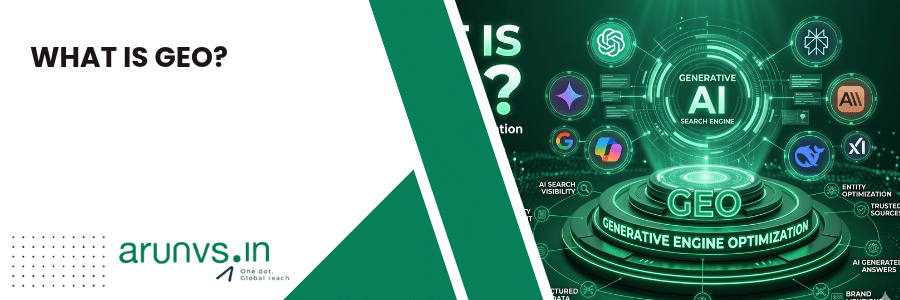
What Is GEO?
Generative Engine Optimisation (GEO) is the process of structuring your website’s content so that artificial intelligence algorithms are able to understand it, trust it and refer it when generating responses to users’ inquiries.
Unlike traditional SEO, which aims to get pages ranking in search results, GEO is focused on making AI find useful content on your website and reference it in its responses to users’ queries.
In plain language, SEO helps users to find your website. GEO helps AI to recommend it.
That is why many businesses start implementing GEO strategies 2026 next to their existing SEO practices.

Why Is It Becoming More and More Important?
Search behaviour changes. People do not just enter keywords into search engines anymore. They often ask full-fledged questions using AI assistants. They want to receive fast and reliable answers without clicking multiple links.
If the structure of your content is good and your information is trustworthy, AI is more likely to use it when generating responses.
And that is the answer to how to rank in ChatGPT search. There are no loopholes here. You need to publish the content that answers the question in a clear and reliable manner.
How Does GEO Help Your Website Become Visible in AI Search?
● Makes Your Website Easy to Understand
AI likes structured content. It can easily understand websites where everything is arranged logically.
For this reason, AI overview optimization starts from writing good and understandable content instead of trying to please search engines.
● Establishes Trust
AI does not stick to your website alone. Reviews, experts’ mentions, industry articles and trustworthy backlinks all help establish brand authority in AI search.
The more trustworthy your business is presented online, the more likely AI is to refer to it.
● Increases the Quality of Your Content
GEO encourages websites to answer questions properly instead of filling pages with keywords. Helpful explanations, up-to-date information and reliable sources increase your chances of being mentioned.
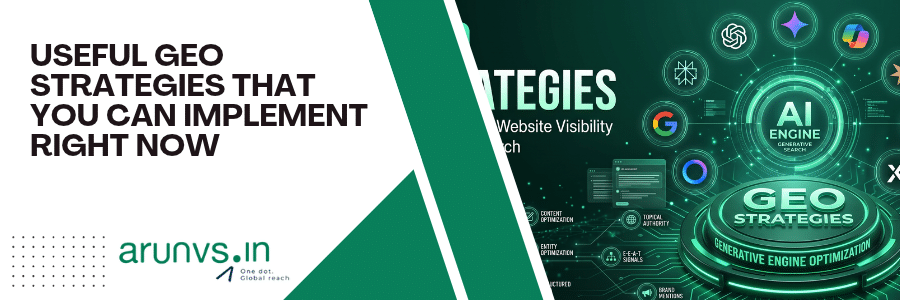
Useful GEO Strategies That You Can Implement Right Now
Some people think that GEO is too technical. But in fact, the basic steps to take are quite simple.
Here are some GEO strategies that can make a real difference:
- Write clear answers at the beginning of each paragraph.
- Create the headings based on the questions that your clients ask.
- Use structured data where appropriate.
- Keep your business information consistent on all online platforms.
- Provide the sources for important facts.
- Receive mentions from respected websites and industry publications.
- Monitor AI visibility along with website traffic.
Conclusion
The behaviour of users changes, and businesses should follow. Implementing GEO strategies is going to allow your website to become better understood by AI tools and thus to be referred by them when people ask questions. Concentrate on producing useful and trustworthy content, answering your customers’ questions and building trust online.
Such efforts will boost your SEO performance as well as AI search visibility in the long run.
Frequently Asked Questions
1. What is the difference between SEO and GEO?
SEO helps your website to rank in traditional search results. GEO is aimed at making AI understand and refer to your content in its generated answers. The two strategies complement each other.
2. How can I improve my chances to appear in ChatGPT search results?
If you want to improve how to rank in ChatGPT search, produce clear and accurate content. Update your information, give answers to your clients’ questions and build your brand authority in AI search.
3. Is GEO helpful only for big businesses?
Not really. Businesses of all sizes can benefit from GEO strategies 2026. Even a small business can be noticed in AI search results if it has helpful and trustworthy content and good structure of the website.
GEO or Generative Engine Optimization is the act of optimizing the content on your website so AI-powered search platforms can understand, identify and maybe cite your information in their results. It is about clear content, useful answers, reliable information and a well-structured site. GEO secures business web presence for next wave of AI search.
GEO helps make the content of your website easier for artificial intelligence systems to read and use when producing replies to user requests. It emphasizes on important information, clear headings, structured material and reliable sources. GEO can increase your chances of getting cited but it’s not a guaranty that you’ll show up in AI-generated answers.
Traditional SEO is the practice of increasing the visibility of a site or a web page in search result pages (SERP) of search engines (organic results). GEO is working on making website information easier for generative artificial intelligence systems to understand and possibly use in AI-generated answers. Both approaches work together to improve your website’s overall discoverability.
People increasingly use AI-powered tools to research products, compare services and find business information. GEO helps businesses organize the content on their website to be better understood by artificial intelligence systems about their offerings and expertise. It is a useful addition to a long-term SEO and digital marketing strategy.
By using GEO practices, you can make your website’s content more understandable and accessible to AI platforms like Google Gemini and Perplexity. All these platforms have their own systems and sources to pull and generate information. Your website may be considered as a source, but no SEO or GEO service can guarantee inclusion in their answers.
Section 2: GEO, AEO and LLM-Friendly Content
SEO (Search Engine Optimization) helps you get more visibility in the traditional search engine results pages for your website. AEO (Answer Engine Optimization) is about providing clear answers to questions, GEO is about making content useful and understandable for generative artificial intelligence systems. Combining all three helps create a website that supports traditional search, answer-based search and AI-powered discovery.
Answer Engine Optimization (AEO) is the process of structuring website content to answer the questions that users ask, directly and clearly. It has questions based headings, short explanations, relevant FAQs and structured information to make it easy to understand the answers. AEO helps get your content ready for answer-focused search experiences like voice search and AI assistants.
LLM-friendly content is written in a way that gives Large Language Models (LLMs) the information context and connections between topics. It has a better language that makes it meaningful headings accurate facts well organized explanations for confusing and repetitive text. This approach helps make website content more accessible to AI-powered information systems.
First you need to know what questions your customers are asking and then create valuable pages that answer those questions directly. Use headings, relevant content, FAQs internal links and proper structured to organize your content. Keep the information accurate updated so visitors and search systems can understand your business.
Good FAQ can help to explain your services and answer specific questions potential for customers commonly ask. Use natural questions as headings . Provide direct , full answers without repeating the same keywords . FAQs support content clarity, but simply adding FAQ schema or more questions does not guarantee AI search visibility.
Section 3: Website Development for GEO and AI Search
Yes, website development can impact every search engines and AI-powered systems can access understand your content. A clear page structure, crawlable content, mobile usage, good performance and appropriate structured and data provide for a better technical foundation. However website development alone cannot guarantee that AI platforms will reference your website.
A good website will have clear service pages informative category pages relevant blog posts and useful FAQ sections. Each page should has cover in single topic and link naturally to related pages via internal links. This can helps visitors and search systems understand your website subjects and how the information is connected.
Schema markup is structured data that helps search engines understand information about your business, services, articles and other website content. Depending on the page, relevant schema types can be Organization, LocalBusiness, Service, Article and BreadcrumbList. Correct schema implementation supports machine understanding, but it does not guarantee AI citations or special search appearances.
Speed and mobile usability are the foundation of both a good website experience and technical SEO. A responsive design means your content will look good on smartphones, tablets and computers. Good performance reduces extraneous waiting. These improvements support your overall search strategy, although speed alone does not determine AI search visibility.
Review your existing pages. Optimize heading, content quality, internal links and technical SEO. Include to have helpful FAQs, also relevant structured data where possible, and give clear descriptions of your products and services. A complete section for redesign is not always necessary if your preent website has a good sound technical foundation.
Section 4: GEO Strategy, Business Growth and AI Search
Local businesses can improve their online information by clearly stating the services they offer, their location, service areas, and business details. Make sure your website, Google Business Profile and any other reliable business listings are consistent and correct. This gives search engines and AI-powered platforms useful information when responding to location-based questions.
Potential customers use AI tools to search for services and compare providers . GEO can help your business get found . Good content, service pages that go into detail, and contact information that’s easy to find will help your visitors better understand what your business has to offer.Actual leads are determined by your services, your competitors, how user-friendly your website is for customers and their willingness to buy.
Start by checking whether search engines can crawl your website and whether your important service pages provide clear, useful information. Review your technical SEO, structured data, content quality, business information and visibility across relevant AI search platforms. You can also monitor referral traffic and manually test relevant customer questions to understand where your business appears.
First make sure that search engines can crawl your site and that your main service pages contain clear and helpful information. Audit your technical SEO, structured data, content quality, business information and how visible you are on the relevant AI search platforms. You can also full monitor referral traffic and manually test full relevant customer questions to understand where your business appears.
You will get a professional SEO & GEO audit of your website to discover content and technical issues and to create an optimization plan according to your business goals. In Normal SEO, AEO, GEO, structured data, content structuring and website improvements as required. Our service provider can explains the strategy clearly that focuses on measurable improvements rather than promising guaranteed AI rankings or citations.