
Search habits have changed. People still use Google, but many also turn to ChatGPT, Google AI Overviews, Gemini, and other AI-powered search tools to find answers. In such circumstances, the approach to search optimisation needs to change as well.
If you limit yourself to traditional SEO, you can miss a great number of opportunities for reaching out to your target audience.
On the other hand, there is no reason to abandon everything that was working before. A new effective strategy should combine search optimisation with AI-friendly content.
That’s where Answer Engine Optimisation (AEO) and Generative Engine Optimisation (GEO) come in. Learn how they differ to create relevant and effective content.
What Is AEO?
Answer Engine Optimisation (AEO) implies the creation of content aimed at providing people with an answer fast. The search engine or the AI assistant prefers content that explains the topic in plain language without asking users to browse through long paragraphs.
An effectively optimised AEO page typically includes the following features:
- The page answers the question in the introductory part.
- The headings and paragraphs are easy to follow.
- The page uses the Frequently Asked Questions (FAQs).
- The content uses structured data, if needed.
- The information is credible and verifiable.
In this case, the chances of appearing in featured snippets, voice searches, and AI overview optimization increase significantly.
What Is GEO?
Generative Engine Optimisation (GEO) is aimed at increasing the chance for your content to be used by the AI search platforms as references while generating an answer.
GEO differs from AEO in that the former takes into account the content of your website as a whole and not just the page that contains the answer to the user’s question.
Effective GEO strategies 2026 include the following steps:
- Publishing original content based on experience.
- Exploring the related topics in detail.
- Regular updating of articles.
- Creation of a trustworthy image on the Internet.
- Getting mentions on credible websites.
- Keeping consistent business information all over the Internet.
As the importance of AI search grows, brand authority in AI search becomes more and more significant because only credible brands have higher chances to be mentioned in AI-generated responses.
AEO vs GEO: Real Differences Between Them
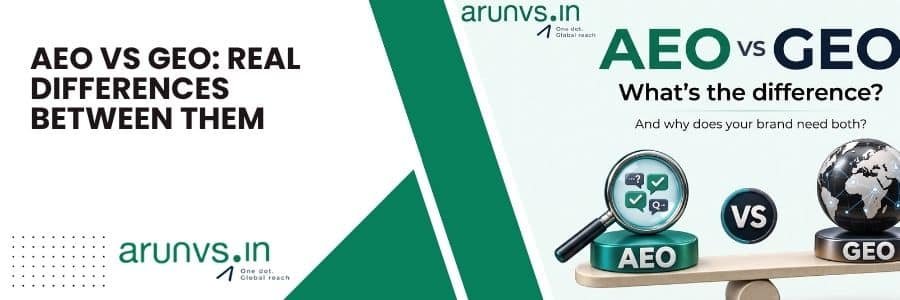
Despite the common goal of the two strategies, they solve different tasks.
| AEO | GEO |
| Helps search engines find direct answers | Helps AI platforms recognise trusted sources |
| Focuses on individual pages | Focuses on overall website authority |
| Supports featured snippets and voice search | Supports AI-generated recommendations |
| Prioritises clear structure | Prioritises expertise, trust, and topical depth |

Which One Should You Use?
The answer is both strategies.
The first strategy helps people find a direct answer, while the second helps the AI system recognise that your business is worthy of being recommended.
For example, if someone searches for how to rank in ChatGPT search, the AI system doesn’t look only at the number of keywords. The system pays attention to the accuracy, structure, recency, and expertise of the content as well.
Similarly, Google has explained that its AI-powered search engines rely on the same principles of high-quality content that have long been key to good SEO. Helpful, credible content, expertise, and trustworthy information remain key factors.

Practices that Work for Both Strategies
Fortunately, many practices support both AEO and GEO.
- Write for the user first and for the search engines then.
- Answer the questions earlier.
- Support important claims with credible sources.
- Update the pages regularly as the information changes.
- Create topic clusters, not isolated blogs.
- Improve brand authority in AI search through the regular publication of credible and useful content.
- Implement the best practices of AI overview optimization with the help of clear headings and logical structure.
- Use GEO strategies 2026 along with traditional SEO fundamentals instead of replacing them.
Conclusion
Despite the changes in search, the main task of search remains the same: people are looking for answers from reliable and trustworthy businesses. This is why AEO and GEO work best together.
AEO helps you to make the content more comprehensible, whereas GEO helps to build the trust that the AI systems take into account before suggesting a source. The companies that will start implementing these strategies today will be in a much better position tomorrow when the search will change again.
If you want to improve the visibility and credibility of your business and increase your profits in the long run, it is the right time to start implementing GEO strategies 2026 and creating helpful content for your audience.
Frequently Asked Questions
1. Does GEO replace traditional SEO?
No. GEO adds to traditional SEO and does not replace it. Good technical SEO, helpful content, and positive user experience stay important. GEO just increases the visibility of your content in AI-generated search results.
2. How can I get higher positions in ChatGPT search?
If your aim is how to rank in ChatGPT search, focus on the original content, expertise, organisation of the information, updating the articles, and the development of authority in the topic area rather than keywords only.
3. Why is brand authority important for AI search?
AI search systems prefer to mention companies that have a reputation for publishing credible information. That is why the regular publication of high-quality content increases the chance of gaining brand authority in AI search.